
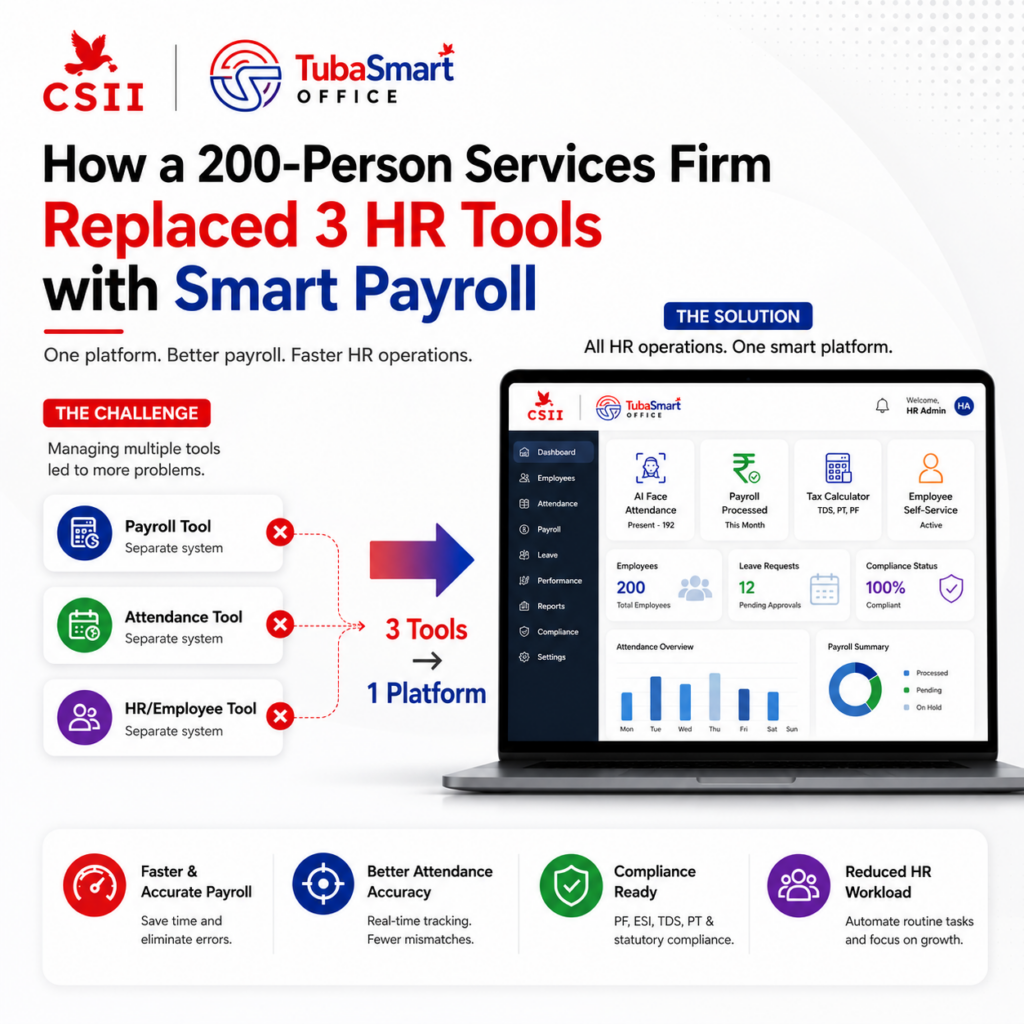
How a 200-Person Services Firm Replaced 3 Disconnected HR Tools with Smart Payroll
Managing scaling workforce operations across multiple fragmented legacy systems was freezing growth. Discover how a prominent Indian services company eliminated manual synchronization traps, payroll disputes, and compliance blindspots by modernizing into a singular enterprise matrix.
1 Unified
System Replacing 3 Siloed ToolsZero
Manual Data Translation Overhead100%
Compliance & Audit ReadinessThe Reality of Tool Sprawl and Operational Confusion
The company operated with separate isolated software systems for payroll calculation, daily attendance logs, and base employee records. Instead of driving performance, this fragile layout forced the core HR team to act as manual routers—handling duplicate data entries, fighting offline validation cycles, and leaving executive leadership with zero centralized visibility.
The Bottleneck: As headcounts crossed the 200-person mark, the business reached an operational ceiling. HR spent days resolving retroactive mistakes instead of driving strategic talent management.
Why HR Operations Reached an Unmanageable Breakdown
Without a singular data source, operational discrepancies began to compound month-over-month, impacting every facet of the corporate structure:
Payroll Delays & Errors
Manual balancing cross-checks across files triggered chronic timeline shifts and calculation updates.
Inconsistent Attendance
Mismatched records from distributed offices and on-site logs led to consistent tracking variances.
Remote Workforce Blindspots
Lack of live geo-spatial or biometric tracking for field operators left field activity completely unverified.
Eroding Internal Trust
Recurring disputes regarding opaque leave balance balances and slow payslip distribution cycles.
Consolidating with Smart Payroll by CSII
The company executed a deep systemic clean-up, deprecating the three disjointed legacy tools in favor of CSII’s unified automation framework. The onboarding focused on automating critical validation gates and building immediate visibility loops from raw check-in to final statutory payout calculation engines instantly.
Centralizing core records, automated leave workflows, approval paths, and legislative rules directly under one central administrative dashboard.
Facial Recognition
AI-driven biometric validation parameters to eliminate manual attendance cross-checking entirely.
Geo-Location Tracking
Enforces location-verified mobile punches for distributed outstation and field teams.
Self-Service
Direct portal access allowing employees to download slips and track balances without taxing HR resources.
The Operational Turnaround After Implementation
Transitioning into a unified environment delivered radical, measurable optimization paths across the corporate landscape within the initial cycles. By coupling core workflows with live data streams, administrative strain dissolved.
The HR division was fully liberated from tedious mathematical reconciliation tasks, transitioning their focus exclusively toward strategic resource management and scaling operations.
Accelerated Cycles
Drastic acceleration in processing speed coupled with total calculations precision.
Locked Compliance
Dynamic, system-enforced guardrails protecting the enterprise from PF, ESI, and TDS audit exposure lines.
Transparent Culture
Immediate mitigation of employee tracking disputes via accurate real-time profile visibility.
Is Fragmented Tool Sprawl Slowing Down Your Workforce Scaling?
Deploy CSII India’s unified AI-powered automation solutions to secure enterprise-grade stability, iron out administrative friction, and eliminate compliance liabilities under a singular dashboard.
Why the Organization Substituted Spreadsheets for CSII
A structural view of the systemic advantages delivered across the business after consolidating architecture components:
| Operational Vector | Legacy Multi-Tool Layout | The Unified CSII Framework |
|---|---|---|
| Data Synchronization | Manual CSV exports, file translation steps, and chronic tracking delays. | Instantaneous data loop updates from employee check-in to backend systems. |
| Compliance Calculations | Handled on offline workbooks by generalists; high penalty risks. | Automated, built-in legislative guardrails aligned with current frameworks. |
| Field Staff Visibility | Unverified tracking reliant on WhatsApp or physical logs. | Geo-fenced mobile punches providing location-verified verification. |
| Employee Experience | Opaque leave records and manual requests driving internal friction. | Complete autonomy through direct self-service profile panels. |
Secure Sustainable Automation via CSII Smart Payroll Solutions
Backed by over three decades of developing robust large-scale computational engines for complex public sectors, government frameworks, and enterprise spaces, CSII India injects unmatched stability into growing modern operations. Clean up resource leakages, fix compliance vulnerabilities, and protect your margins before operational friction risks your business scaling loops.