
Why Month-End Payroll Feels Broken at Most Indian SMEs (And What to Actually Fix)
Month-end payroll is one of the most stressful operational bottlenecks for growing businesses in India. If your HR team constantly fights fragmented spreadsheets, manual compliance traps, and employee disputes, you're not facing a payroll problem — you're running a broken system.
8+ Days
Wasted on Manual Balancing100%
Real-Time Attendance SyncZero
Spreadsheet Compliance RiskThe Reality Most Growing Companies Internalize
Every payroll cycle rolls out exactly the same way: late nights, cross-referencing mismatched biometric logs, chasing down WhatsApp leaves, and building bespoke formulas in over-complicated Excel logs. While this setup functions when you have a small core team, it quickly breaks as operations begin to scale.
The final outcome: Payroll week leaves your HR team processing retroactive adjustments instead of pushing forward high-impact talent operations, while business owners take on immense statutory liability.
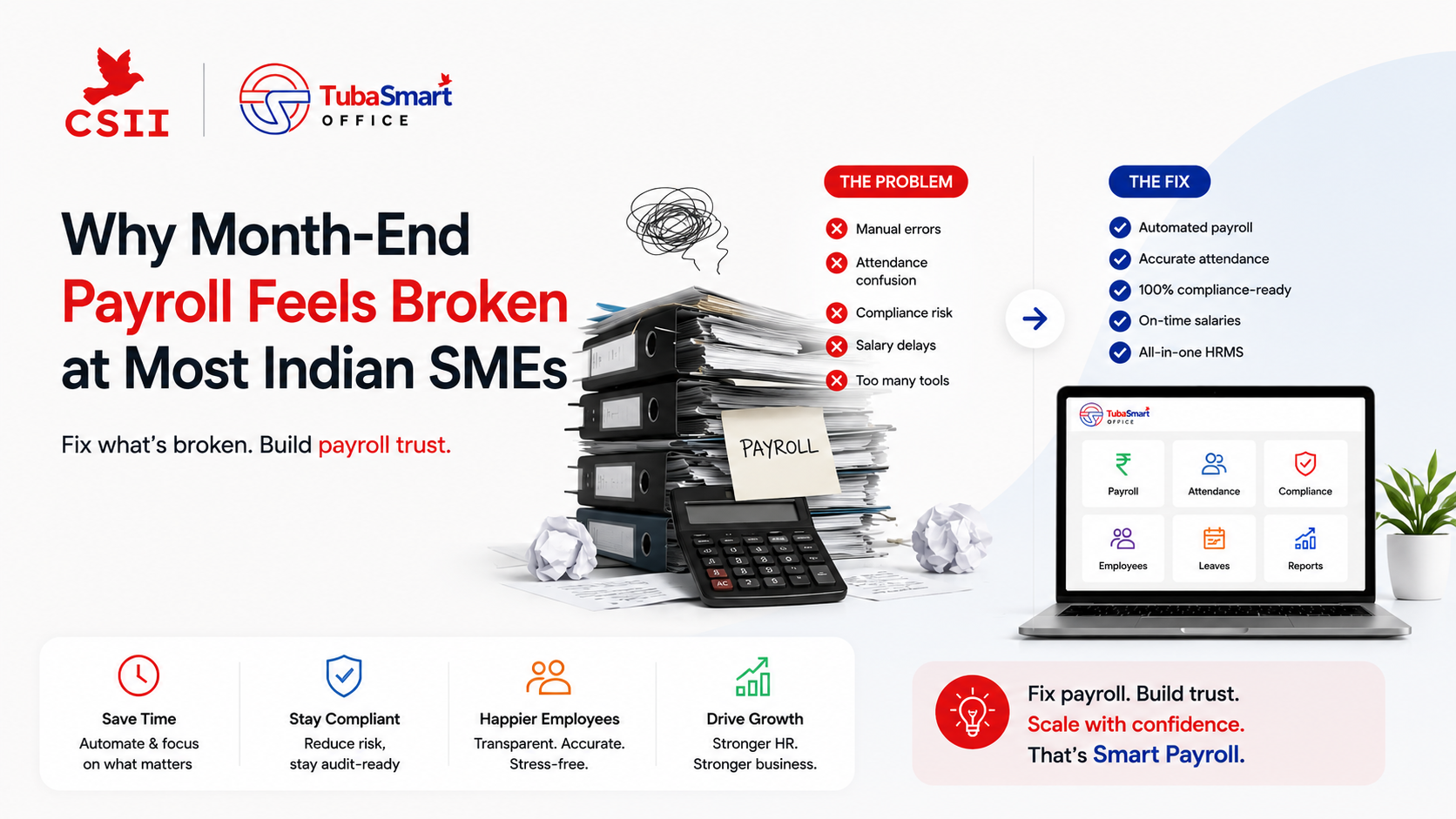
Common Payroll Blindspots Faced By Growing Indian SMEs
By month-end, small to medium enterprise teams spend more time putting out administrative fires than running accurate payroll calculations. The issues surface across every touchpoint of your operations:
Attendance Mismatches
Fragmented attendance files that fail to align seamlessly with active payroll sheets, driving chronic payment disputes.
Compliance Penalties
Calculations for PF, ESI, and TDS handled outside verified logic engines, leaving the entity open to deep audit risks.
Disconnected Tools
Managing isolated configurations for leave tracker panels, field staff locations, and employee databases simultaneously.
Eroding Employee Trust
Friction caused by unpredictable salary processing, unexpected deduction logs, and hidden leave balance profiles.
Attendance Data Is Inherently Inaccurate
Most payroll execution failure points map cleanly back to upstream time tracking systems. Relying on disconnected legacy biometrics, physical logbook counters, or manual messages forces manual validation layers.
For operations utilizing distributed field teams, or hybrid workspaces, lacking localized real-time tracking transforms standard verification routines into administrative gridlock.
Unsynchronized data logs introduce systemic tracking variances, unverified overtime claims, delayed salary releases, and consistent management friction.
Deploy cloud-native processing equipped with Facial Recognition Attendance and geo-fenced mobile check-ins that directly populate structural payroll engines instantly.
Real-Time
Sync rate from employee mobile check-in to payroll workspace backend dashboards.
Geo-Fencing
Enforces location-verified punches for distributed outstation and field workforces.
100%
Elimination of cross-checking errors between separate attendance trackers.
Too Much Heavy Manual Spreadsheet Processing
Constructing core salary computations inside offline workbooks leaves execution tethered to human limitations. Tracking custom deductions, pro-rata adjustments, bonus lines, and dynamic structural parameters becomes unsustainable past a minor headcount threshold.
Relying on manual formulas creates a critical operational bottleneck. If processing depends entirely on one person's proprietary spreadsheet formulas, your business scaling introduces structural vulnerability.
Transition tracking over to automated calculations that account for leave variances, instantly compute gross adjustments, and deliver structured payslips instantly across the workforce.
Zero Formula
Errors caused by manual spreadsheet cell copying, broken lookups, or unverified modifications.
Instant
Payslip distribution to the entire company directly upon payout confirmation.
Single Source
Of truth across all structural payouts, bonus balances, and localized deductions.
Ready to Transition Past Spreadsheet Chaos and Multi-System Fragility?
CSII India's unified automation platform consolidates time tracking, dynamic leave monitoring, automated statutory structures, and complete compliance infrastructure under one unified hub.
Compliance Management Is Too Complicated for Generalists
Navigating the active shifts across Indian statutory processing introduces steep challenges for internal administrative teams. Balancing PF frameworks, ESI updates, dynamic TDS tables, and specific state Professional Tax rules manually is highly prone to oversight.
Filing delays, improper tier categorizations, or calculation errors can trigger severe late interest charges and sudden regulatory audit complications.
Embed localized legislative rules directly into your core engine so every allocation, deduction, and reporting component adjusts dynamically to updated limits.
Automated
Deduction allocation across PF, ESI, and localized statutory structures.
Audit-Ready
Filing documentation and consolidated ledger summaries compiled automatically.
100% Locked
System parameters aligned with verified 2026 central and state payroll frameworks.
HR Teams Are Fatigued by Broken Tool Sprawl
Operating one disconnected software for time tracking, a standalone tracker layout for leave planning, and manual workbooks for payout execution causes massive data drag. Siloed apps create immediate operational overhead.
Siloed systems generate constant data mapping delays, slow authorization loops, complex administrative tasks, and complete visibility blocks for the executive layer.
Consolidate your entire HR delivery stack inside an all-inclusive framework where operational updates dynamically reflect across your entire payroll matrix.
One Interface
To access leave pipelines, shift calendars, performance items, and core payouts.
Transparency
Through robust employee self-service panels reducing manual HR requests.
Zero Scrape
No tedious data translation tasks or CSV transformations required at month-end.
The Monthly SME Compliance Timeline That Leaves Zero Margin for Error
For growing businesses across India, missing operational timelines directly creates legal risks and financial overheads. Managing these dependencies manually is no longer viable:
| Monthly Date | Statutory Dependency | Impact of Manual Slip |
|---|---|---|
| 7th | TDS Deposit Filing | Late submissions prompt immediate 1.5% monthly compound interest penalty lines. |
| 15th | PF & ESI Returns (ECR) | Delays trigger portal lockouts, sudden recovery tracking, and penalty interest. |
| 20th | GSTR Payout Sync | Direct friction on cross-functional working capital cash flows across finance teams. |
| Quarterly | Form 24Q Consolidation | Prolonged processing stops accurate structural tax credit distribution for employees. |
Why Your Workforce Suffers Under Broken Administrative Processes
Payroll friction directly erodes employee experience. When team members run into persistent payment delays, unclear salary reductions, or opaque leave records, workplace trust degrades rapidly. True retention relies on operational consistency.
Deploying comprehensive self-service portals empowers your workforce to verify their profiles, view leave structures, and download certified documentation instantly — taking the burden off your core HR desk.
Scale Your Business Infrastructure via CSII Smart Payroll
Backed by over three decades of engineering large-scale transactional platforms for complex government agencies, public sectors, and high-growth corporations, CSII India brings enterprise-grade stability to small and medium enterprises. Our unified TubaSmart HRMS & Payroll Solutions clean up manual workflow noise, fix compliance vulnerabilities, and centralize operational data loops into one highly secure workspace.